Tuesday, January 22, 2013

Polycarbonate Saves Eyes!

Hello everyone,

I've written a blog article before about the confusion involved with the various lens materials and coatings to choose from when purchasing eyeglasses (found here). One of these choices is polycarbonate, the most shatter resistant lens material. There is another lens material called Trivex with the same properties. It is technically not shatter-proof, but it resists impact better than other lenses (plastic and glass).

I had a patient come into the office last week telling me about an eye injury that took place a little while ago that caused him to go to the emergency room. He gave me permission to use his story in order to educate others about what happened to him. Here's what happened:

The patient was moving a piece of drywall into his attic. The entry to the attic was through a drop-down door from the ceiling, with the attached ladder. In order for the piece of drywall to fit through the space, the patient had to remove the springs from the ladder to allow a wider opening. After the patient successfully moved the drywall, the patient replaced the one end of the spring and attached it to a pin. As the patient was reaching for a nut to screw down the end of the spring to the pin, the spring let loose and whapped the patient in his left eye! Fortunately, the patient was wearing eyeglasses with polycarbonate lenses.

Here is what the frame and lens looked liked. The frame was completely mangled, and the patient said the lens was found later on the floor several feet away. Just the force of the impact created an indentation into the lens and bent the lens edge.

 (The mangled frames.)


 (You can see the indentation into the lens from the force of the spring.)


 (The edge of the lens from the impact. You can see how the force physically dented the lens.)

The patient was rushed to the ER with a nose fracture, and bleeding and inflammation in the eye, as well as bruising and swelling to his eyelids. When he came into my office to tell the story, he mentioned that the bleeding and inflammation had almost completely resolved, but that the vision wasn't quite the same as the non-impacted eye. However, I told him that if he would have chosen regular plastic lenses for his eyeglasses, he probably would have lost the eye.

So, the lesson here is...consider switching to polycarbonate lenses when purchasing your next pair of eyeglasses. The doctor makes eyeglasses recommendations for good reason. I am very happy that this patient of mine followed through on my recommendation.

Polycarbonate saves eyes!

Sincerely,
Dr. Weaver


Wednesday, January 2, 2013

New Year's Resolution: To See Everything Clear This Year (and Avoid the Bad Eye Diseases)

Hello everyone,

First of all, Happy New Year! I'm writing this blog post from my underground bunker, just in case the Mayans were off by a couple of weeks. I am hopeful the apocalypse will not occur anytime soon, but to be sure, I'll just stay down here a couple of more days with my crates of bottled water and rations of Twinkies and astronaut food, doing eye exams by candlelight...

Well, as it is evident, no one can see the future, but you can see the present. But can you see the present CLEARLY? Or is it a blurry, headache, squinty mess that makes you avoid or quit reading, using a computer, watching television, or any other visual task?

However, clear vision is only a part of the equation. You may be able to see "Eagle Eye better than 20/20 vision" without eyeglasses or contact lenses, but can you be absolutely sure there isn't a suspicious looking growth the size of Mount Vesuvius in the peripheral retina of your right eye? My personal recommendation is an annual eye exam to not only check vision, but to check the health of the eyes for cataracts, glaucoma, macular degeneration, and a plethora of non-symptomatic eye diseases. For example:

1) Cataracts = usually an age-related condition. The older you get, the higher the risk of cataract formation. Cataract formation due to age is typically a slow, gradual change. Also, changes may occur in one eye more than the other, causing vision changes to go unnoticed. These changes include: blurred vision, increased glare and light sensitivity, difficulty driving at night or reading in dim illumination (restaurants), and a diminution of colors. Researchers have linked nutrients such as lutein/zeaxanthin, vitamin C, vitamin E and zinc to reducing the risk of eye diseases such as cataracts.

2) Glaucoma = also an age-related condition, but can happen at any age. Glaucoma is irreversible damage to the optic nerve causing vision loss that is related to high pressures in the eyes. So, the older you get and the higher the intraocular pressure, the higher the risk of developing glaucoma. A family history of glaucoma is also a risk factor. Glaucoma causes vision loss to the peripheral vision first, and then begins to impact the central vision in mid- to late stages of glaucoma. Any vision loss is not recoverable, so treating glaucoma in its early stages is important to prevent blindness. The only way to tell is if you have high intraocular pressures is to get them measured at an eye exam: the air puff OR the yellow numbing drop combined with the blue light. And if there is a high suspicion of glaucoma, your eye doctor will recommend additional medical testing to check for evidence if glaucoma is taking place: computerized peripheral visual field test (sensitive test for peripheral visual field changes), optic nerve photography and/or optic nerve scanning laser tomography (documents changes to the optic nerve appearance over time), corneal pachymetry (front of the eye thickness), gonioscopy (are the drainage angles in the eye open?) and repeat intraocular pressure measurements (measurements can vary throughout the day). YES, it's pretty involved!

3) Macular degeneration = again, an age-related condition. This condition causes central vision loss due to structural damage to the macular region of the retina, the very center most portion responsible for fine, central visual acuity. There is a "dry" and "wet" form of the disease, and there are varying levels of severity. Unfortunately, both forms are bad to have, and the condition only progresses causing vision deterioration as time goes on. Blurred vision may be the start of this disease. So, if left undiagnosed, it can get shot to H-E- double hockey sticks in a hurry. Again, at least yearly exams and macula photography or macular tomography is important to document change. Multivitamins formulated for macular degeneration have been shown to slow down the advanced stages of macular degeneration. Oh, and AVOID SMOKING! Smoking quadruples the risk of developing macular degeneration!

4) Eye lesions = can happen anywhere and anytime. The develop of benign and malignant lesions are usually related to lengthy exposure to UV rays (outdoors, tanning booths). They can happen on the eyelid, the inner part of the eyelid, the white part of the eye, the colored part of the eye (iris) and even the back of the eye (choroidal nevus). The nevi (freckles) typically occur on the iris and the choroid. Just like suspicious-looking freckles on the skin checked at regular intervals for changes in size, shape, and color, so should any suspicious areas of the eye be checked.

Dilating the eyes is important to make sure the entire eyeball is healthy, so that the eye doctor can look into your eye with a wide-open pupil that doesn't constrict when the light is shined into it. If you've never had your eyes dilated, let me tell ya', it's loads of fun! Actually, I'm biased. The majority of non-eye doctors would easily admit they'd rather have a tooth pulled sans novocaine...but dilating the eyes are important to make sure that Mount Saint Helens sized retinal lesion (yes, it's getting bigger!) isn't happening at all.

The take home message is that not all eye diseases are created equal. Some diseases are not a big deal, some cause vision loss that is not detectable by the patient until it's too late, and some diseases may be a sign of more serious conditions, such as cancer.

If you've never had the dilating drops at wherever you get your eyes examined, do your eyes and yourself a favor and go somewhere that does. You only get one set of eyes, and you want them to outlast your body so that you can see everything as clear as possible until your last day on earth (which may, or may not, be caused by an apocalyptic event).

Sincerely,
Dr. Weaver


Ps. And in case you don't know where we are, below is a picture of our sign visible from Rt. 183 (across the street from Boyer's Food Market). Drive into the parking lot and come on in! Welcoming New Patients!


Monday, December 10, 2012

Keep Your Eyes for Christmas...

Hello everyone,

'Tis the season to be jolly. Fa la la la la, la la, la...ouch!

That is the unfortunate version of Deck the Halls when a hazardous toy causes injury to an unsuspecting child. Each year, there are many "hot" toys, the toys that you can't find in stores anymore, and can only purchase at a premium on eBay or Craigslist.

However, each year, there are also the "worst" toys, the toys that have a high probability of causing injury, and even death, to young children. As an optometrist, I'm concerned for the toys causing an eye injury. As a parent, I'm concerned for any toy that can cause any type of injury, especially those that are choking hazards for my 8 month old girl.

The World Against Toys Causing Harm (W.A.T.C.H.) group has a top ten hazardous toys list of 2012. Here they are:

1) This “fishing game” is sold online for 16-month-old children, however, the packaging contains a warning of a choking hazard for children under 3 years old.  The plastic fishing pole uses common twine to attach a small, magnetic lure. The brightly-colored plastic lure, whether detached or connected to the approximately 9”-long cord, poses a serious potential choking hazard for oral-age children.

 2) Children as young as 3 years old are encouraged to “climb inside” this colorful inflatable ball, in order to “Bounce, Spin, Roll, Tumble!” The box, which portrays unsupervised children playing with the oversized inflatable ball, cautions that adult supervision is “required”. However, the toy itself indicates that adult supervision is only “recommended”.

3) The manufacturer of this dart gun with two “revolving barrels” encourages children to load the ammunition cartridge and fire “6 darts in seconds!”  Despite the manufacturer’s directive that this toy not be sold for children younger than 6 years old, it was marketed online for babies as young as 7 months old. The gun can shoot the supplied darts with enough force to potentially cause eye injuries.

4) This wooden “kneeboard”, marketed for young children, sits approximately 4 inches off the ground.  Users are encouraged to “race your friends!” by kneeling on the board and steering with the handlebars. Its low profile makes the toy potentially hazardous for outdoor use, an issue purportedly addressed with a separate, detachable “safety flag”. Additional warnings on the package insert include: “Kneeboard riding can be a hazardous activity.  Kneeboards can and are intended to move, and it is therefore possible to get into dangerous situations and/or lose control and/or fall off.  If such things occur, serious injury may result.”

5) Despite the industry’s standard requiring strings on playpen and crib toys to be less than 12 inches in length, manufacturers are still permitted to market “pull toys” such as this “Vtech Baby Explore & Learn Helicopter” with a cord measuring approximately 24 inches. Sold to reward “baby’s curiosity”, the manufacturer “encourages little ones to discover and learn with a cute puppy friend!” The toy is intended for babies as young as 12 months old and thus, is a prime candidate for crib and playpen injuries.

6) Young children are encouraged to combine two swords into one “Megablade” in order to “arm yourself for the ultimate battle experience….”  The “double sword” measures “over 4.5 feet long!”  The blade has the potential to cause facial or other impact injuries.

7) This water balloon “launcher” is marketed with the capability to shoot water balloons “at high speeds of up to 75 mph.” Remarkably, the device, which the manufacturer admits “can cause severe injury or facial damage….”, was marketed and sold by at least one online retailer for babies as young as 8 months old.  Balloons are also well known by the toy industry as posing a significant risk of choking, and are, therefore, not permitted to be sold for use by oral-age children.

8) The manufacturer encourages children to “become a Power Ranger” by donning “battle gear”, including this “shogun helmet”.  The headgear includes an attachable “crown” with pointed, rigid plastic tips as long as approximately 9”, with the potential for penetrating impact and puncture wound injuries.

9) This toy xylophone includes colorful blocks of various sizes, which can be “arranged & rearranged”, allowing oral-age children to “create their own melodies!”  Babies as young as twelve months old are encouraged to use a supplied slender, wooden dowel as a drumstick to play music on the xylophone. The approximately 5” drumstick, which is not connected to the xylophone, could be mouthed and occlude a child’s airway.

10) These over-sized fists, resembling those of a popular Marvel comic book and movie character, are sold to enable three year olds to “be incredible like The Hulk” by “smashing everything that gets in their way!”  No warnings or cautions are provided.

From the kids' perspective, these toys are AWESOME! I mean, what boy wouldn't want to put on Hulk fists and pulverize anything in his path? As a parent, common sense must prevail when buying toys for the kiddos...and don't be afraid to return gifts given by others that may pose a potential threat to your child.

Avoid the toys with sharp points or objects, that launch or fire projectiles, small pieces as a choking hazard to little ones, laser pointers (very, VERY bad for the eyes), and anything that encourages hitting someone else (a la Gamma Green Smash Fists).

That is all. Have a Merry and Safe Christmas!

Sincerely,
Dr. Weaver

Friday, November 9, 2012

Marketing Consultant Search...

Hello everyone,

As a new practice, it's very important to get the word out about myself and the services that my practice offers. We know it only takes time, and advertising with the Reading Eagle, the Merchandiser, Yellowbook and postcard mailers have been working pretty well. Word of mouth referrals have really been the best method, so far, but that takes time as more people learn that there's an eye doctor in Bernville. (Yes, many people still do not know that there is an eye doctor in Bernville, despite being open almost two years!!!)

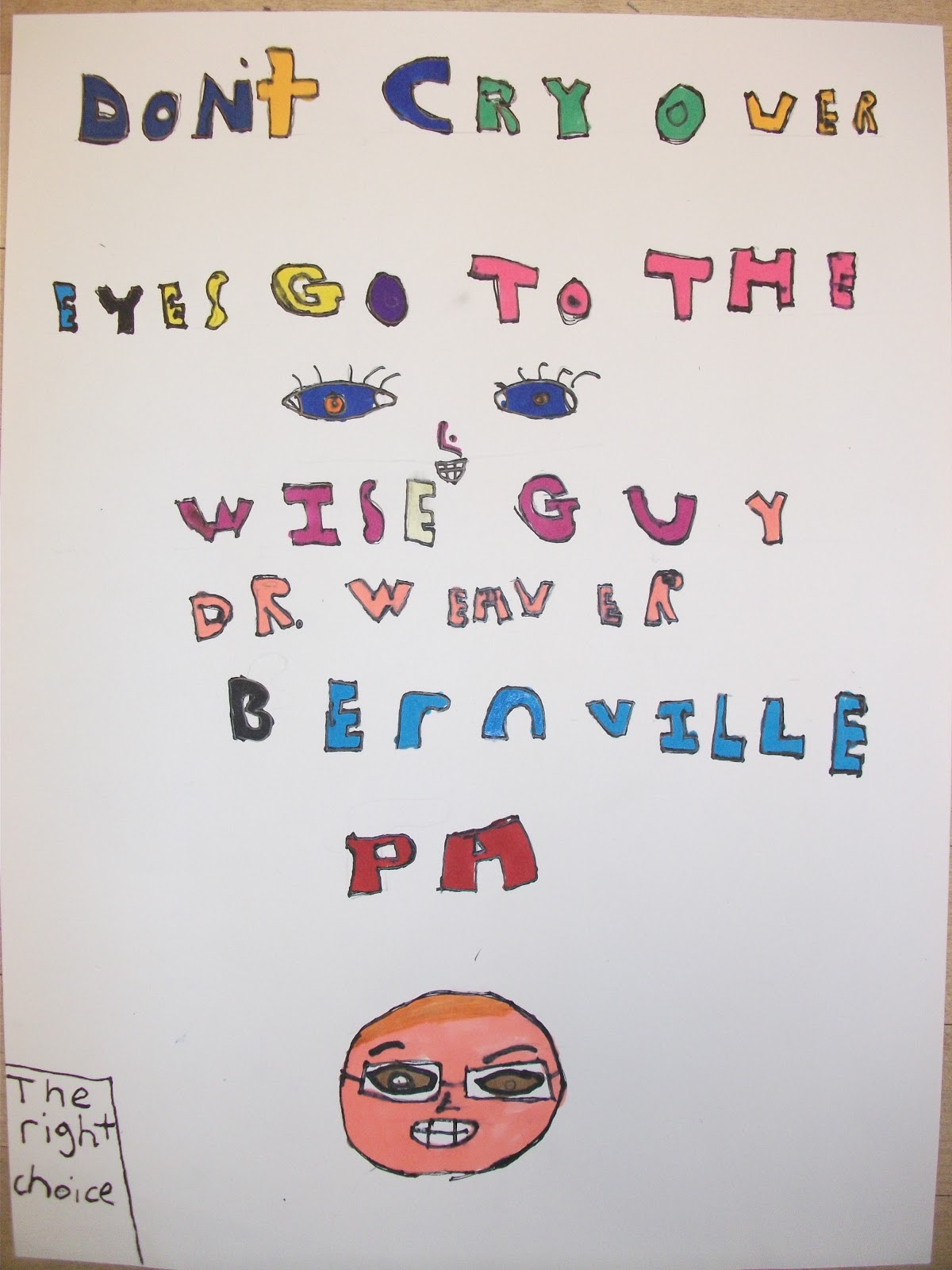
So, I decided that I needed to increase my external marketing campaign by enlisting the help of fifth graders of the Tulpehocken School District. Below are the ten finalists for my marketing campaign. To vote, go to our Facebook page and Like and/or leave a Comment for each picture. Each Like and Comment acts as a vote. Dr. Weaver will make the final selection for the first, second and third place prizes to win $50, $25 and $15 respectively. The winners will also have their posters frames and mounted on the walls of Weaver Eye Care Associates! Cool, huh?


REMEMBER! Go to our Facebook page to vote! Have fun!

Sincerely,
Dr. Weaver

Wednesday, October 10, 2012

Halloween Contact Lenses


Hello everyone,


Halloween is approaching. For some, it's just another day. For others, it's a chance to hand out (and eat) candy and get dressed up in an outfit you wouldn't otherwise wear on any other day of the year.

Having the right accessory to the Halloween costume is also very important. Imagine walking around dressed up as Moses: long robe and white hair/beard combo. You HAVE to cut out two large pieces of cardboard to make the Ten Commandments to go with the costume, or else you'd look like some sleepwalking old guy asking for candy.

Well, Halloween contact lenses are an accessory as well, and they are very popular. I have fit them at my office and they look really cool!

The Reading Eagle newspaper did a write-up on Halloween contact lenses (in which Dr. Weaver is featured!!!) talking about the importance of getting properly fitted to reduce the risk of potential vision-threatening problems with these type of lenses.

The issue with the "Halloween" contact lenses is that, even though they are cosmetic to enhance the appearance of the eyes, they are still considered medical devices (just like regular colored contact lenses) and require a prescription to be sold (state law). In general, a soft contact lens prescription consists of power, curvature, diameter and brand/material of contact lens. An optometrist evaluates the vision, fit and comfort for a specific lens and releases the prescription once everything appears great at the eye exam, so that the patient can purchase their supply of contact lenses for which they were fitted.

Individuals who buy these Halloween contact lenses without a prescription (online or specialty stores) may not even know how to insert, remove or take care of the lenses properly. And if not used properly, contact lenses can lead to many problems: dryness, irritation, allergy, inflammation, corneal ulcers, and potentially vision loss.

So, if a patient chooses a lens in which they've never been fitted, such as a Halloween contact lens, it's not guaranteed the the lenses will fit properly. However, when properly fitted and dispensed in an optometry office, the risk of potential problems are reduced.

So, if you are interested in accessorizing your Halloween costume this year, or would just like to wear funky contact lenses all year long, set up a contact lens evaluation sooner than later, because it takes some time to coordinate the ordering of the contacts and scheduling the contact lens fitting exam.

Sincerely,
Dr. Weaver

Monday, September 10, 2012

Weaver Eye Care Associates...Winners for the 2012 Berks Mont Blue Ribbon Award!!!

Thanks to everyone who wrote in Weaver Eye Care Associates on their nomination forms online and in the paper. We had the most votes for "Best Eye Care" practice in Berks County for the 2012 Berks-Mont Blue Ribbon Awards. We had no idea and were really surprised, considering we just opened up last year and don't have as many patients as other more well-established eye care practices. However, it seems that the patients that we do have are AWESOME!!! Keep spreading the word and Weaver Eye Care Associates will be around for a long time.


From myself and the staff members, we thank you!!!

Tuesday, September 4, 2012

Contact Lens Problems Anyone?


Hello,

You finally took the big step and switched from wearing eyeglasses to contact lenses. You heard the numerous positives points about wearing contacts and wanted to give it a try. But now that you’re finally in contact lenses, why is it that your vision doesn’t seem as clear? Or why do your eyes feel dry towards the end of the day? Or why does your vision fluctuate when you’re reading or using a computer for hours at a time?
This guy is having a rough day of contact lens wear.
The primary issue that affects the quality of vision and comfort-related complications is how well a person takes care of their contact lenses. When people start having visual complaints or problems with redness, dryness and intolerance issues, usually it is because the lenses are taken care of poorly.

Overwearing lenses is a major problem that can lead to many complications. If you are wearing the contact lenses every waking moment, or even sleeping in them, you are cutting off the supply of oxygen to the cornea, the part of the eye on which the contact lens sits. Decreasing the oxygen supply to the cornea principally causes inflammation and dryness, but can also lead to the formation of corneal ulcers and bacterial infections that could potentially be sight threatening. Wearing lenses past the recommended replacement schedule should also be avoided. Most issues arise out of patients extending the life of their lenses, such as wearing two-week disposable lenses for a month, or a monthly disposable lens for a couple of months. I’ve actually seen patients wear a daily 1-day disposable lens for weeks. That’s a big no-no! Every contact lens was manufactured for use in a specific way, and altering its intended use will cause issues with dryness, poor vision and the lenses not fitting properly.
Giant Papillary Conjunctivitis = Bumps underneath the upper eyelid,
an allergy reaction to contact lens wear
Poor cleaning habits also lead to contact lens problems. The contact lens case that you have should be replaced frequently. Whenever you purchase contact lens solution, it always comes with a new case, so use it. Old contact lens cases harbor nasty bacteria, so replacing your contact lens case regularly reduces your exposure to bacterial eye infections. Also, it is important to throw out the used solution in your contact lens case every morning and let the case air dry. Re-using solution for days at a time allows bacteria to proliferate in the dark, warm and moist environment, essentially turning your case and your contact lenses into a Petri dish.
The small white dots are corneal infiltrates, signs of
corneal inflammation secondary to contact lens overwear.
However, a lot of people are very responsible and do take care of their contact lenses very well. Using artificial tear lubricating drops may help them, but they may still have issues. There are literally hundreds of different brands of contact lenses out on the market, and obviously, they are not all manufactured in the same way. If you weren’t fitted recently with contact lenses by your eye doctor, chances are you aren’t wearing the latest and greatest contact lens technology. These new contact lens materials allow more oxygen to cross the contact lens to your cornea, greatly reducing the risk of dryness and comfort problems.

Patients may also have an underlying dry eye condition, or ocular allergies, which makes wearing contact lenses difficult. There are contact lens cleaning solutions that are available that are preservative-free. Many times, people develop a hypersensitivity to the preservatives found in many multi-purpose cleaning solutions, and just switching to a different solution takes care of their sensitive eyes problem.

So, if you are having any contact lens related problems, it is recommended that you seek the advice from an eye care professional, certainly someone who specializes in contact lenses. Your eye doctor can examine your eyes and contact lenses and make the proper recommendations to improve your situation with contact lenses.

Sincerely,
Dr. Weaver