Thanks to everyone who wrote in Weaver Eye Care Associates on their nomination forms online and in the paper. We had the most votes for "Best Eye Care" practice in Berks County for the 2012 Berks-Mont Blue Ribbon Awards. We had no idea and were really surprised, considering we just opened up last year and don't have as many patients as other more well-established eye care practices. However, it seems that the patients that we do have are AWESOME!!! Keep spreading the word and Weaver Eye Care Associates will be around for a long time.
From myself and the staff members, we thank you!!!
Monday, September 10, 2012
Tuesday, September 4, 2012
Contact Lens Problems Anyone?
Hello,
You finally took the big step and switched from wearing
eyeglasses to contact lenses. You heard the numerous positives points about
wearing contacts and wanted to give it a try. But now that you’re finally in
contact lenses, why is it that your vision doesn’t seem as clear? Or why do
your eyes feel dry towards the end of the day? Or why does your vision
fluctuate when you’re reading or using a computer for hours at a time?
This guy is having a rough day of contact lens wear.
The primary issue that affects the quality of vision and comfort-related
complications is how well a person takes care of their contact lenses. When
people start having visual complaints or problems with redness, dryness and
intolerance issues, usually it is because the lenses are taken care of poorly.Overwearing lenses is a major problem that can lead to many complications. If you are wearing the contact lenses every waking moment, or even sleeping in them, you are cutting off the supply of oxygen to the cornea, the part of the eye on which the contact lens sits. Decreasing the oxygen supply to the cornea principally causes inflammation and dryness, but can also lead to the formation of corneal ulcers and bacterial infections that could potentially be sight threatening. Wearing lenses past the recommended replacement schedule should also be avoided. Most issues arise out of patients extending the life of their lenses, such as wearing two-week disposable lenses for a month, or a monthly disposable lens for a couple of months. I’ve actually seen patients wear a daily 1-day disposable lens for weeks. That’s a big no-no! Every contact lens was manufactured for use in a specific way, and altering its intended use will cause issues with dryness, poor vision and the lenses not fitting properly.
Giant Papillary Conjunctivitis = Bumps underneath the upper eyelid,
an allergy reaction to contact lens wear
Poor cleaning habits also lead to contact lens problems. The contact lens case that
you have should be replaced frequently. Whenever you purchase contact lens
solution, it always comes with a new case, so use it. Old contact lens cases
harbor nasty bacteria, so replacing your contact lens case regularly reduces
your exposure to bacterial eye infections. Also, it is important to throw out
the used solution in your contact lens case every morning and let the case air
dry. Re-using solution for days at a time allows bacteria to proliferate in the
dark, warm and moist environment, essentially turning your case and your
contact lenses into a Petri dish.
The small white dots are corneal infiltrates, signs of
corneal inflammation secondary to contact lens overwear.
However, a lot of people are very responsible and do take care of their contact
lenses very well. Using artificial tear lubricating drops may help them, but
they may still have issues. There are literally hundreds of different brands of
contact lenses out on the market, and obviously, they are not all manufactured
in the same way. If you weren’t fitted recently with contact lenses by your eye
doctor, chances are you aren’t wearing the latest and greatest contact lens
technology. These new contact lens materials allow more oxygen to cross the
contact lens to your cornea, greatly reducing the risk of dryness and comfort
problems.
Patients may also have an underlying dry eye condition, or ocular allergies, which makes wearing contact lenses difficult. There are contact lens cleaning solutions that are available
that are preservative-free. Many times, people develop a hypersensitivity to
the preservatives found in many multi-purpose cleaning solutions, and just
switching to a different solution takes care of their sensitive eyes problem.
So, if you are having any contact lens related problems, it is recommended that you seek the advice from an eye care professional, certainly someone who specializes in contact lenses. Your eye doctor can examine your eyes and contact lenses and make the proper recommendations to improve your situation with contact lenses.
Sincerely,
Dr. Weaver
Thursday, August 2, 2012
Buying eyeglasses should not be confusing...but it is!
Hello everyone,
When getting new eyeglasses, it can be
daunting when trying to decide what kind of special tints and
coatings you need on your eyeglass lenses. Also, picking out the frames can be an ordeal itself. (Do they look good? Do they fit good? Do you like them? Do I like them? What is the warranty? etc.)
So, I figured it would be a good idea to write an article so that anyone getting new eyeglasses can make an informed decision, which should make the whole process of buying new eyeglasses a little less stressful.
Single Vision Lenses and Bifocal Lenses:
The choice is a little easier if you need single vision lenses. Single vision lenses contain just one prescription in the lens, for near or for far. Typically, those patients under 40-years-old who have good focusing ability just need single vision lenses. However, for those with focusing problems, bifocal lenses are typically required.
If you are at the (dreaded) bifocal stage, the first choice is to decide between a bifocal and a trifocal option. A bifocal lens allows you to see at two separate points, far distance (driving, watching TV) and near (usually between 12 to 16 inches). A trifocal has a third section in the middle portion of the lens that allows a clearer view of an intermediate distance (between 2 to 3 feet) that is typically “washed-out” or blurred when trying to look through bifocals. The typical bifocal and trifocal are called “lined” bifocals or trifocals, because there is an actual line that is visible on the lens that separates the distance and near portions of the lens.
Lined Bifocals/Trifocals vs. No-line Progressive Lenses:
The next decision involves either choosing the “lined” bifocal/trifocal or going with a “no-line” progressive lenses. There are benefits to both types of lenses. With a line bifocal/trifocal, it is usually easier to switch between the reading and distance portion of the lens. The “lined” bifocals/trifocals are also usually less-expensive compared to the specialty design of progressive lenses and have a quicker adaptation period.
Progressive lenses are cosmetically appealing, because there are no lines visible on the lens. These types of lenses also provide the most complete range of vision, allowing you to see from far distance all of the way to your reading vision, depending on where you look through the lens. People typically had trouble adapting to the older styles of progressive lenses. However, progressive lens designs have gotten better over the last few years, causing less distortion and better adaptation.
After choosing the single vision lenses or bifocal type, there are different types of lens materials, coatings and tinting options. What you decide on depends on your lifestyle and the type of work and hobbies that you perform.
Plastic, Polycarbonate, Glasses and Hi-Index (ultra-thin) Lenses:
Most lens materials are made out of plastic, which is very safe, but not shatter-resistant. If you do a lot of work that requires a great deal of eye safety, polycarbonate is the most shatter-resistant material available. Children and those who are monocular should be in this material because it is the safest lens option.
Glass lenses are still available. It is usually more expensive than plastic and polycarbonate. However, plastic and polycarbonate are prescribed more because the optics are still excellent, and they are more light-weight and have a better safety profile.
A high index plastic lens is lightweight and thinner than all other lens materials. Individuals with a very high prescription always had to deal with thick lens edges in glasses that would weigh heavily on the bridge of the nose. The high index can be used for any prescription, but it is especially recommended for those individuals with high prescriptions to allow the glasses to be lighter and more cosmetically appealing.
Scratch Resistant Coatings:
If you use your glasses extensively, or tend to throw them around a bit, you may want to consider a scratch-resistant coating. This can be placed on any type of lens material, but is always recommended for polycarbonate, since it tends to scratch more easily than other materials. The coating adds a layer of warranty on your eyeglasses lenses. If you're hard on your eyeglasses, they will still probably scratch with or without the scratch resistant coating. However, the warranty usually allows the lenses to be remade (at little or no cost) if they get scratched from normal use. If you run over your glasses with your car and the asphalt demolishes your lenses, the warranty of "normal use" would not apply.
Anti-reflective (anti-glare) Coating:
I always recommend an anti-reflective coating, which is also called an anti-glare coating. This coating reduces reflections on the eyeglass lenses, and helps in a variety of ways. Primarily, the anti-reflective coating allows more natural light to enter your eyes, which in turn provides clearer vision. It reduces night-time glare from headlights or streetlamps, reduces eye fatigue from moderate reading or computer use, and can reduce light sensitivity during the day and at night. Some people refuse getting this because the coating “flaked-off” or “pealed-off” on a previous pair of eyeglasses. The new quality coatings do not tend to "flake" or "peal." However, let me point out that there are many different manufacturers of coatings, and therefore, different qualities of coatings. My practice typically uses the high end quality lenses and lens materials, versus optical labs with high volume or online resellers.
UV Coating:
If you are outdoors a lot, you may want an ultraviolet coating, or UV coating. The UV coating is a clear coating on the lens that protects your eyes while you are outside from harmful UV rays. UV can cause cancer of the skin around the eye and of the eye itself, as well as possibly promote the development of cataracts and macular degeneration.
Tints and Transition Lenses:
Tinting is also a great feature if you spend a lot of time outdoors or are a person who is light sensitive. There are solid tints that are same color throughout the whole lens and graded tints that are darker at the top and lighter at the bottom of the lens. There are also many different color options when prescribing a tint. Certain colors are preferable to specific activities, such as fishing, hunting and playing golf to enhance contrast and reduce glare. There are also lenses that darken when activated by sunlight. These types of lenses are called Transitions, or photograys. The older style of these lenses used to take a long while when changing from dark to light, but the newer technology allows this change to occur much faster. One thing to point out is that Transition lenses are activated by UV light. The car windshields and windows contain a UV blocking material, which is why Transition lenses don't get dark in the car unless you have a window rolled down or a moon-roof open. If you're looking for a darkened lens option for driving a car, polarized sunglasses would be the better option.
Polarized Lenses:
Polarized lenses reduce the amount of reflected glare off of surfaces, allowing for clearer vision and reduced light sensitivity. It is definitely recommended for boaters or fishermen to reduce the issues caused by the sun reflecting off of the water’s surface. However, polarized lenses also reduce glare for many other activities, such as driving, skiing, golfing, and running.
So, as you can see, the added features are very helpful in a variety of ways. Your eye doctor (hopefully, me!), along the help with the optical department, can assist you in selecting the special features that would aid you the most. As a new practice, I handle all of the measurements on the optical side of the practice as well, so you can be assured that I give you the proper recommendation and fitting when it comes to your new eyeglasses.
If you are at the (dreaded) bifocal stage, the first choice is to decide between a bifocal and a trifocal option. A bifocal lens allows you to see at two separate points, far distance (driving, watching TV) and near (usually between 12 to 16 inches). A trifocal has a third section in the middle portion of the lens that allows a clearer view of an intermediate distance (between 2 to 3 feet) that is typically “washed-out” or blurred when trying to look through bifocals. The typical bifocal and trifocal are called “lined” bifocals or trifocals, because there is an actual line that is visible on the lens that separates the distance and near portions of the lens.
Lined Bifocals/Trifocals vs. No-line Progressive Lenses:
The next decision involves either choosing the “lined” bifocal/trifocal or going with a “no-line” progressive lenses. There are benefits to both types of lenses. With a line bifocal/trifocal, it is usually easier to switch between the reading and distance portion of the lens. The “lined” bifocals/trifocals are also usually less-expensive compared to the specialty design of progressive lenses and have a quicker adaptation period.
Progressive lenses are cosmetically appealing, because there are no lines visible on the lens. These types of lenses also provide the most complete range of vision, allowing you to see from far distance all of the way to your reading vision, depending on where you look through the lens. People typically had trouble adapting to the older styles of progressive lenses. However, progressive lens designs have gotten better over the last few years, causing less distortion and better adaptation.
After choosing the single vision lenses or bifocal type, there are different types of lens materials, coatings and tinting options. What you decide on depends on your lifestyle and the type of work and hobbies that you perform.
Plastic, Polycarbonate, Glasses and Hi-Index (ultra-thin) Lenses:
Most lens materials are made out of plastic, which is very safe, but not shatter-resistant. If you do a lot of work that requires a great deal of eye safety, polycarbonate is the most shatter-resistant material available. Children and those who are monocular should be in this material because it is the safest lens option.
Glass lenses are still available. It is usually more expensive than plastic and polycarbonate. However, plastic and polycarbonate are prescribed more because the optics are still excellent, and they are more light-weight and have a better safety profile.
A high index plastic lens is lightweight and thinner than all other lens materials. Individuals with a very high prescription always had to deal with thick lens edges in glasses that would weigh heavily on the bridge of the nose. The high index can be used for any prescription, but it is especially recommended for those individuals with high prescriptions to allow the glasses to be lighter and more cosmetically appealing.
Scratch Resistant Coatings:
If you use your glasses extensively, or tend to throw them around a bit, you may want to consider a scratch-resistant coating. This can be placed on any type of lens material, but is always recommended for polycarbonate, since it tends to scratch more easily than other materials. The coating adds a layer of warranty on your eyeglasses lenses. If you're hard on your eyeglasses, they will still probably scratch with or without the scratch resistant coating. However, the warranty usually allows the lenses to be remade (at little or no cost) if they get scratched from normal use. If you run over your glasses with your car and the asphalt demolishes your lenses, the warranty of "normal use" would not apply.
Anti-reflective (anti-glare) Coating:
I always recommend an anti-reflective coating, which is also called an anti-glare coating. This coating reduces reflections on the eyeglass lenses, and helps in a variety of ways. Primarily, the anti-reflective coating allows more natural light to enter your eyes, which in turn provides clearer vision. It reduces night-time glare from headlights or streetlamps, reduces eye fatigue from moderate reading or computer use, and can reduce light sensitivity during the day and at night. Some people refuse getting this because the coating “flaked-off” or “pealed-off” on a previous pair of eyeglasses. The new quality coatings do not tend to "flake" or "peal." However, let me point out that there are many different manufacturers of coatings, and therefore, different qualities of coatings. My practice typically uses the high end quality lenses and lens materials, versus optical labs with high volume or online resellers.
UV Coating:
If you are outdoors a lot, you may want an ultraviolet coating, or UV coating. The UV coating is a clear coating on the lens that protects your eyes while you are outside from harmful UV rays. UV can cause cancer of the skin around the eye and of the eye itself, as well as possibly promote the development of cataracts and macular degeneration.
Tints and Transition Lenses:
Tinting is also a great feature if you spend a lot of time outdoors or are a person who is light sensitive. There are solid tints that are same color throughout the whole lens and graded tints that are darker at the top and lighter at the bottom of the lens. There are also many different color options when prescribing a tint. Certain colors are preferable to specific activities, such as fishing, hunting and playing golf to enhance contrast and reduce glare. There are also lenses that darken when activated by sunlight. These types of lenses are called Transitions, or photograys. The older style of these lenses used to take a long while when changing from dark to light, but the newer technology allows this change to occur much faster. One thing to point out is that Transition lenses are activated by UV light. The car windshields and windows contain a UV blocking material, which is why Transition lenses don't get dark in the car unless you have a window rolled down or a moon-roof open. If you're looking for a darkened lens option for driving a car, polarized sunglasses would be the better option.
Polarized Lenses:
Polarized lenses reduce the amount of reflected glare off of surfaces, allowing for clearer vision and reduced light sensitivity. It is definitely recommended for boaters or fishermen to reduce the issues caused by the sun reflecting off of the water’s surface. However, polarized lenses also reduce glare for many other activities, such as driving, skiing, golfing, and running.
So, as you can see, the added features are very helpful in a variety of ways. Your eye doctor (hopefully, me!), along the help with the optical department, can assist you in selecting the special features that would aid you the most. As a new practice, I handle all of the measurements on the optical side of the practice as well, so you can be assured that I give you the proper recommendation and fitting when it comes to your new eyeglasses.
Take care,
Dr. Weaver
Dr. Weaver
Wednesday, June 20, 2012
June is Cataract Awareness Month
Hello everyone,
June
is Cataract Awareness Month. There are many different types of
cataracts, which can arise from many contributing factors: trauma,
long term steroid use, high-risk medications and health conditions,
such as diabetes. However, the most common cataracts are due to
increasing age.
Cataracts
are a very common eye condition that becomes even more likely to
occur as an individual gets older. People are living
longer lives these days, so cataracts are becoming more prevalent.
According
to the World Health Organization, cataracts are responsible for 51%
of world blindness, affecting about 20 million people. In 2008, the
National Eye Institute and Prevent Blindness America said in the
United States, nearly 22 million Americans age 40 and older have
cataracts. At age 80, more than half of those Americans have
cataracts.
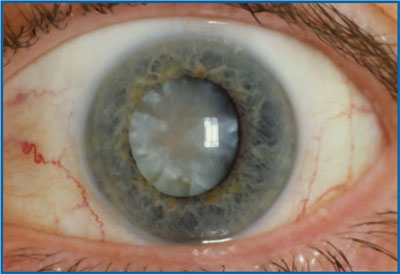
Don't let cataracts get this bad. This is a fairly dense cataract.
A
cataract is a clouding of the eye’s natural lens. At birth, the lens is crystal clear. As one gets older,
the lens becomes cloudier, and visual complaints of decreased vision
and glare become more apparent.
Cataracts
can be prevented to some degree. The Mayo Clinic suggests having
regular eye exams, as directed by your eye doctor, which can help
detect cataracts and other eye diseases at their earliest stages.
Smoking has been linked to cataract progression. The cessation of
smoking, as well as maintaining a healthy weight and eating a healthy
diet, can help reduce the risk of cataract progression.
Probably
the easiest thing a person can do to help prevent cataracts is to
wear UV-blocking sunglasses. UV radiation has
been linked to the development of certain types of cataracts, as well
as macular degeneration. Wearing sunglasses should start at a young
age, because approximately 50% of our lifetime UV exposure will occur
before the age of 18.
The
progression of a cataract is typically a slow, gradual change. Some
patients are very susceptible to changes in their vision. However,
many patients don’t realize there is a vision problem until they
are evaluated at an eye exam. Most likely, this is because a patient
is always using both eyes together, and typically do not notice
vision changes if only one eye is getting worse. When the quality of
life is affected by poor vision, and that vision cannot be improved
by updating the patient’s eyeglasses prescription, then cataract
surgery is warranted.
No cataract on the left. Cataract on the right scattering light,
causing glare, light sensitivity and blurred vision.
I
have seen patients wait a bit too long for fear of cataract surgery. Their vision progressively gets worse despite
recommendations to have the surgery performed. There are risks to any
surgery, but the risks of major complications of cataract surgery in
the hands of a skilled surgeon are very low.
Some
of those risks include increased pressure in the eyes, inflammation,
and infection. However, any patient undergoing cataract surgery is
monitored closely in the post-operative period by the surgeon or
co-managing optometrist, and given anti-inflammatory and
anti-bacterial eye-drops to facilitate the healing process.
Usually
when a patient has surgery in one eye, their first question is, "How
soon can I get the other eye done?" When the
surgeon removes the cloudy cataract and replaces it with a clear
intra-ocular lens, the reported brightness of colors and image quality
by the patient is astounding.
In
individuals over the age of 60, the American Optometric Association
recommends an annual eye exam, including dilation of the eyes, to
evaluate the vision and to check for cataracts and other ocular
conditions. Since cataracts can occur at any age, it's important to
get regular eye exams for all individuals young and old, even if
one's vision seems adequate.
Sincerely,
Dr. Weaver
Tuesday, June 5, 2012
Glasses that help you lose weight?
Hello everyone,
I must admit that I constantly check the Internet for all of my news gathering. I can't remember the last time I've watched a televised news program. As for newspapers, I read the Sunday edition of the Reading Eagle...and when I mean "read," I mean skim over the titles and reading only one or two articles that interest me. The Internet provides me with news instantly, rather than learning about it on TV or print many hours later.
Well, I read an article on Yahoo about something called Diet Glasses. From The Herald Sun, "Tokyo University professor Michitaka Hirose (R) and his team developed a camera-equipped special goggle, which makes cookies bigger to help users' diet at his laboratory in Tokyo on June 2, 2012. Hirose conducted an experiment, asking examinees to eat as many cookies as they want with and without the glasses. The results showed they ate 9.3 percent less on average with the goggle showing cookies 1.5 times bigger than they actually are and ate 15 percent more with cookies looking two-thirds of their real size."
I had just written a blog post about the Project Glass by Google with augmented reality glasses to add information to one's perception. However, these glasses designed by Hirose augments reality by "fooling" one's perception. The computer attached to the special goggles keeps the individual's hand size the same, while increasing or decreasing the size of the object they are picking up.
Hirose is interested in the study of virtual reality, where reality is perceived by the mind. His science team created a device that fooled the brain by changing the image one would normally see. The device is not for commercial use, but they are considering using such a device to help individuals lose weight my changing their perception: making the food look bigger so that the individual would eat less without the use of diet-modulating drugs.
It's like an optical illusion. For example, when a full moon is very low on the horizon, it also looks humongous! But try taking a picture of the moon when it's at that low position on the horizon. The moon isn't actually bigger, it's the same size as when it's high in the sky...the photograph will reveal this. Check out Wikipedia for more information on the Moon Illusion.
So, what's next for augmented reality glasses? Project Glass, Hirose's Oreos, and then what? I hope the major food manufacturers don't try to get all of us to wear the Hirose goggles so that they can make their food in smaller portion sizes. I'm already getting only 10 chips in a large bag of Lay's in the first place.
And Nabisco, don't even think about making the Oreo's smaller...bigger would be okay, though. Maybe moon-sized?
Take care,
Dr. Weaver
I must admit that I constantly check the Internet for all of my news gathering. I can't remember the last time I've watched a televised news program. As for newspapers, I read the Sunday edition of the Reading Eagle...and when I mean "read," I mean skim over the titles and reading only one or two articles that interest me. The Internet provides me with news instantly, rather than learning about it on TV or print many hours later.
Well, I read an article on Yahoo about something called Diet Glasses. From The Herald Sun, "Tokyo University professor Michitaka Hirose (R) and his team developed a camera-equipped special goggle, which makes cookies bigger to help users' diet at his laboratory in Tokyo on June 2, 2012. Hirose conducted an experiment, asking examinees to eat as many cookies as they want with and without the glasses. The results showed they ate 9.3 percent less on average with the goggle showing cookies 1.5 times bigger than they actually are and ate 15 percent more with cookies looking two-thirds of their real size."
This Oreo looks humongous! Chomp, chomp, chomp, chomp...can I have another, please?
I had just written a blog post about the Project Glass by Google with augmented reality glasses to add information to one's perception. However, these glasses designed by Hirose augments reality by "fooling" one's perception. The computer attached to the special goggles keeps the individual's hand size the same, while increasing or decreasing the size of the object they are picking up.
Hirose is interested in the study of virtual reality, where reality is perceived by the mind. His science team created a device that fooled the brain by changing the image one would normally see. The device is not for commercial use, but they are considering using such a device to help individuals lose weight my changing their perception: making the food look bigger so that the individual would eat less without the use of diet-modulating drugs.
Red pill, blue pill...you mean I'm a human battery?
It's like an optical illusion. For example, when a full moon is very low on the horizon, it also looks humongous! But try taking a picture of the moon when it's at that low position on the horizon. The moon isn't actually bigger, it's the same size as when it's high in the sky...the photograph will reveal this. Check out Wikipedia for more information on the Moon Illusion.
So, what's next for augmented reality glasses? Project Glass, Hirose's Oreos, and then what? I hope the major food manufacturers don't try to get all of us to wear the Hirose goggles so that they can make their food in smaller portion sizes. I'm already getting only 10 chips in a large bag of Lay's in the first place.
And Nabisco, don't even think about making the Oreo's smaller...bigger would be okay, though. Maybe moon-sized?
Take care,
Dr. Weaver
Wednesday, May 23, 2012
Oogle with Google
Hello,
There seems to be some technology that may just be hype for now...but here it is. Google has something called Project Glass. They're building a prototype for an augmented reality head-mounted display, which means they're trying to develop glasses that allow you to take photos, identify objects in reality, head's-up display for your calendar, tweets, Facebook status, read text messages and emails...all by looking and using your voice.
If they can make these in prescription-ready glasses in a variety of styles, I think that the curiosity of tech-lovers will cause Project Glass to become a very popular item (just think of the Apple junkies waiting in line at the Apple store for the latest iPads and iPhones). I've already informed the Project Glass team on Google+ that I'd like to be a beta tester (as well as millions of other folks). We'll see if that really happens.
As far as optics, I'm not sure how the technology works...how it projects all of the displays, photos and videos for the wearer to see them. But some information is coming out...
According to well-informed Google blogger Seth Weintraub, Google's Project Glass glasses will probably use a transparent LCD or AMOLED display to put information in front of your eyeballs. It's location-aware thanks to a camera and GPS, and you can scroll and click on information by tilting your head, something that is apparently quite easy to master. Google Glasses will also use voice input and output.
The New York Times says that the glasses will run Android, will include a small screen in front of your eye and will have motion sensors, GPS and either 3G or 4G data connections. Seth Weintraub also stated that the device is designed to be a stand-alone device rather than an Android phone peripheral. Project Glass can connect to a smartphone via Wi-Fi or Bluetooth 4.0 and communicates directly with the Cloud. There is also a front-facing camera and a flash, but the most recent prototype's screen isn't transparent.
The concept has me excited personally, just to see how it works and its capabilities. But the question is, do I really need something like this? The answer is probably no, because I like my current pair of eyeglasses and my Motorola Photon just fine. Do I really want people's tweets and text messages popping up in my vision every five seconds? It seems that it could be distracting from the actual reality. I'd rather have my phone in my pocket and I'll check out my messages when I'm ready.
Feel free to comment if you have any thoughts!
Thanks,
Dr. Weaver
There seems to be some technology that may just be hype for now...but here it is. Google has something called Project Glass. They're building a prototype for an augmented reality head-mounted display, which means they're trying to develop glasses that allow you to take photos, identify objects in reality, head's-up display for your calendar, tweets, Facebook status, read text messages and emails...all by looking and using your voice.
If they can make these in prescription-ready glasses in a variety of styles, I think that the curiosity of tech-lovers will cause Project Glass to become a very popular item (just think of the Apple junkies waiting in line at the Apple store for the latest iPads and iPhones). I've already informed the Project Glass team on Google+ that I'd like to be a beta tester (as well as millions of other folks). We'll see if that really happens.
As far as optics, I'm not sure how the technology works...how it projects all of the displays, photos and videos for the wearer to see them. But some information is coming out...
According to well-informed Google blogger Seth Weintraub, Google's Project Glass glasses will probably use a transparent LCD or AMOLED display to put information in front of your eyeballs. It's location-aware thanks to a camera and GPS, and you can scroll and click on information by tilting your head, something that is apparently quite easy to master. Google Glasses will also use voice input and output.
Project Glass makes this guy happy!
The New York Times says that the glasses will run Android, will include a small screen in front of your eye and will have motion sensors, GPS and either 3G or 4G data connections. Seth Weintraub also stated that the device is designed to be a stand-alone device rather than an Android phone peripheral. Project Glass can connect to a smartphone via Wi-Fi or Bluetooth 4.0 and communicates directly with the Cloud. There is also a front-facing camera and a flash, but the most recent prototype's screen isn't transparent.
The concept has me excited personally, just to see how it works and its capabilities. But the question is, do I really need something like this? The answer is probably no, because I like my current pair of eyeglasses and my Motorola Photon just fine. Do I really want people's tweets and text messages popping up in my vision every five seconds? It seems that it could be distracting from the actual reality. I'd rather have my phone in my pocket and I'll check out my messages when I'm ready.
Feel free to comment if you have any thoughts!
Thanks,
Dr. Weaver
Monday, May 7, 2012
Allergies are at it again!
Hello everyone,
Well, the grass in my yard finally grew enough to get cut lately. It's early May, and I've only have to cut it 2 times so far! It's been a pretty dry Spring, but the recent rains in early May is making that grass grow like crazy (especially after I did the annual Scott's treatment). Those two cuts were within the past week! But with the growing grass, comes the allergens: grass pollen, tree pollen, flowers blooming. There's a lot of stuff in the air right now.
Regarding the eyes, the main symptoms of ocular allergies are itching, watering and redness. Itching is the biggie! If your eyes are itchy, most likely it is allergies, but other conditions can cause itchy, watery, red eyes: contact lens overwear, blepharoconjunctivitis, viral conjunctivitis, etc.
Oral allergy medications do work well to stifle the sniffles. It works good for anything inside the head: stuffy/runny nose, sneezing, congestion. However, the issue with allergy medications is that they tend to dry out the eyes, which can make your eye allergy symptoms worse. It's best to have something to use directly on the eye if your eyes are suffering from allergies.
The main tip is to NOT rub your eyes. This tends to release more histamine, which causes more itching and redness...it's a never-ending cycle. The best supportive therapy is cold compresses 5 minutes at a time on your closed eyelids as much as possible, but I usually recommend 2-4 times/day. Also, artificial teardrops will wash out any allergens from the eyes, which can cause the release of histamine and the itching, redness, watering symptoms. So use artificial tears as needed to help you out.
However, if that isn't enough, there are many over-the-counter allergy drops that work well. The main thing that you want is an anti-histamine and a mast cell stabilizer in an eyedrop. Alaway and Zaditor are two over-the-counter allergy eyedrops that work well, and both are to be used 2 times/day. If that still isn't doing it for you, you may require prescription treatment and a trip to your eye doctor is in order.
Also, remember...other problems can cause itchy, watering, red eyes. So if your symptoms are not getting better with the supportive therapy, make sure to see your eye doctor so that he/she can diagnose your issue and get you on the right track.
Take care,
Dr. Weaver
Well, the grass in my yard finally grew enough to get cut lately. It's early May, and I've only have to cut it 2 times so far! It's been a pretty dry Spring, but the recent rains in early May is making that grass grow like crazy (especially after I did the annual Scott's treatment). Those two cuts were within the past week! But with the growing grass, comes the allergens: grass pollen, tree pollen, flowers blooming. There's a lot of stuff in the air right now.
Regarding the eyes, the main symptoms of ocular allergies are itching, watering and redness. Itching is the biggie! If your eyes are itchy, most likely it is allergies, but other conditions can cause itchy, watery, red eyes: contact lens overwear, blepharoconjunctivitis, viral conjunctivitis, etc.
Oral allergy medications do work well to stifle the sniffles. It works good for anything inside the head: stuffy/runny nose, sneezing, congestion. However, the issue with allergy medications is that they tend to dry out the eyes, which can make your eye allergy symptoms worse. It's best to have something to use directly on the eye if your eyes are suffering from allergies.
The main tip is to NOT rub your eyes. This tends to release more histamine, which causes more itching and redness...it's a never-ending cycle. The best supportive therapy is cold compresses 5 minutes at a time on your closed eyelids as much as possible, but I usually recommend 2-4 times/day. Also, artificial teardrops will wash out any allergens from the eyes, which can cause the release of histamine and the itching, redness, watering symptoms. So use artificial tears as needed to help you out.
However, if that isn't enough, there are many over-the-counter allergy drops that work well. The main thing that you want is an anti-histamine and a mast cell stabilizer in an eyedrop. Alaway and Zaditor are two over-the-counter allergy eyedrops that work well, and both are to be used 2 times/day. If that still isn't doing it for you, you may require prescription treatment and a trip to your eye doctor is in order.
Also, remember...other problems can cause itchy, watering, red eyes. So if your symptoms are not getting better with the supportive therapy, make sure to see your eye doctor so that he/she can diagnose your issue and get you on the right track.
Take care,
Dr. Weaver
Subscribe to:
Posts (Atom)